

Transform Beautiful Design into Business
Your brand makes a beautiful promise, and so does your design. Ensure that users who decide based solely on design at first glance experience the true and profound value of your product’s performance: Let Yaft Digital help you optimize your frontend development processes.
We can support you if you are experiencing any of the following issues:
• Problems with speed and response time;
• Compatibility issues across devices or browsers;
• Accumulated technical debt in existing frontend code;
• Discrepancy between UI/UX design and development;
• Scalability bottlenecks.
Our Frontend Development Services
Let us seamlessly handle all the details of your frontend development processes for you.
Our Adopted Design Thinking Approach
Design Thinking is an approach to shaping a product’s UI/UX design. As a professional frontend development company that places extra emphasis on aesthetics and user satisfaction, Yaft Digital adopts this approach. We solve complex problems and bring innovative ideas to life by prioritizing empathy, user-centricity, creativity, and collaboration.
Regardless of your application’s purpose or complexity, we develop truly user-friendly products that add value to your customers using the Design Thinking approach.
Our Frontend Development Process
Our Frontend Development Process
We prepare wireframes or mockup interfaces to visualize the layout, structure, and content positions of the user interface. Following your approval, we develop the visual design by defining the color palette, typography, visuals, and other design elements. In the final stage, we present high-fidelity mockups or prototypes, followed by comprehensive development.
The CI/CD pipeline automates code management, quality checks, and deployments. We define the version control system, set up a CI server, and create automated deployment pipelines for staging and production environments. We also configure rollback mechanisms for deployment failures.
We bring designs to life with a component-based architecture. We develop responsive interfaces that comply with accessibility, performance, and SEO principles, adhering to the design system kit.
We ensure secure data exchange between the backend and frontend. API endpoints are integrated, authentication flows are implemented, and error management and monitoring logs are added.
Caching, code and image compression, reducing the number of requests, lazy-loading, and critical path optimizations are performed. Target metrics are achieved with Lighthouse measurements.
Comprehensive functional and visual tests are conducted on Chrome, Safari, Firefox, and Edge using real devices and emulators, as well as on iOS/Android phones and tablets. Errors are fixed and re-verified.
Deployment to the production environment, DNS and SSL configurations, environmental variables, and version tags are completed. Blue-green or phased deployment is implemented if necessary.
Application logs, performance monitoring, alerts, and security updates are continuously managed. Uninterrupted support is provided with periodic backups and improvement recommendations.




Patterns We Prefer in Front-End Development
Component Architecture
It treats software as a structure composed of reusable and self-contained components. Each component represents a specific function and can be combined to create more complex interfaces. Widely used in frameworks like React and Angular; it provides ease of maintenance, testing, and reusability.
Atomic Design
It aims to systematically build user interfaces by breaking them down into the smallest building blocks: atoms (button, input), molecules (combinations of atoms like a search bar), organisms (header, card list), templates (layout arrangements), and pages (full view). It ensures the establishment of a consistent design system and disciplines the development process.
State Management
It covers the storage, updating, and consistent sharing of application data among components. Managing states such as user inputs, settings, or data from external sources is critical for performance, reliability, and user experience. Common tools: Redux, MobX, Vuex (and modern alternatives: Zustand, Pinia).
Server-Side Rendering (SSR)
This is the process of generating page HTML on the server instead of the browser. It improves initial loading time and SEO performance, especially for content-heavy pages. SSR offered by frameworks like Next.js/Nuxt helps search engines crawl content more effectively.
Progressive Web Apps (PWA)
These are web applications that offer an app-like experience using modern web capabilities. Designed to be reliable, fast, and interactive; they can work offline or with low connectivity. They can be “installed” on a device, offer features like notifications, and provide a seamless user experience.
Micro Frontends
This is the adaptation of the microservices approach to the frontend. The interface is divided into small modules/applications that can be developed, deployed, and scaled independently. Each micro frontend can use its own technology stack; it facilitates parallel development in large teams.
Composable Architecture
Instead of a monolithic structure, the frontend is built by combining loosely coupled small components and services. Independent modules can be easily updated or replaced; thus, flexibility and scalability increase, and improvements can be made without affecting the overall system.
Patterns We Prefer in Front-End Development
01
Component Architecture
It treats software as a structure composed of reusable and self-contained components. Each component represents a specific function and can be combined to create more complex interfaces. Widely used in frameworks like React and Angular; it provides ease of maintenance, testing, and reusability.
02
Atomic Design
It aims to systematically build user interfaces by breaking them down into the smallest building blocks: atoms (button, input), molecules (combinations of atoms like a search bar), organisms (header, card list), templates (layout arrangements), and pages (full view). It ensures the establishment of a consistent design system and disciplines the development process.
03
State Management
It covers the storage, updating, and consistent sharing of application data among components. Managing states such as user inputs, settings, or data from external sources is critical for performance, reliability, and user experience. Common tools: Redux, MobX, Vuex (and modern alternatives: Zustand, Pinia).
04
Server-Side Rendering (SSR)
This is the process of generating page HTML on the server instead of the browser. It improves initial loading time and SEO performance, especially for content-heavy pages. SSR offered by frameworks like Next.js/Nuxt helps search engines crawl content more effectively.
05
Progressive Web Apps (PWA)
These are web applications that offer an app-like experience using modern web capabilities. Designed to be reliable, fast, and interactive; they can work offline or with low connectivity. They can be “installed” on a device, offer features like notifications, and provide a seamless user experience.
06
Micro Frontends
This is the adaptation of the microservices approach to the frontend. The interface is divided into small modules/applications that can be developed, deployed, and scaled independently. Each micro frontend can use its own technology stack; it facilitates parallel development in large teams.
07
Composable Architecture
Instead of a monolithic structure, the frontend is built by combining loosely coupled small components and services. Independent modules can be easily updated or replaced; thus, flexibility and scalability increase, and improvements can be made without affecting the overall system.
What You Gain with an Optimized Front-End

Be Future-Ready
As you grow, do not compromise on the gains mentioned above. A well-structured front-end codebase allows you to add new features and content without major interruptions and to scale the product. To achieve this, we implement sustainable code patterns and clean architectural principles; we establish a foundation that enables developers to work with the code more easily in the future.

Keep Users on the Page
Let high bounce rates, unfinished transactions, and abandoned carts be a thing of the past. We ensure users navigate your product comfortably with truly responsive, intuitive, and visually impressive interfaces. We meticulously design screen layouts, considering user behavior and technical constraints, using established design patterns and robust architectural principles (including the GoF approach).

Increase Your Discoverability
Be one Google search away. If SEO is critical for your product, we use server-side rendering (SSR), the best method to support search engine crawling in single-page applications (SPAs). This way, we improve your search visibility and rankings, increasing your project's reach.
Offer Unique Comfort
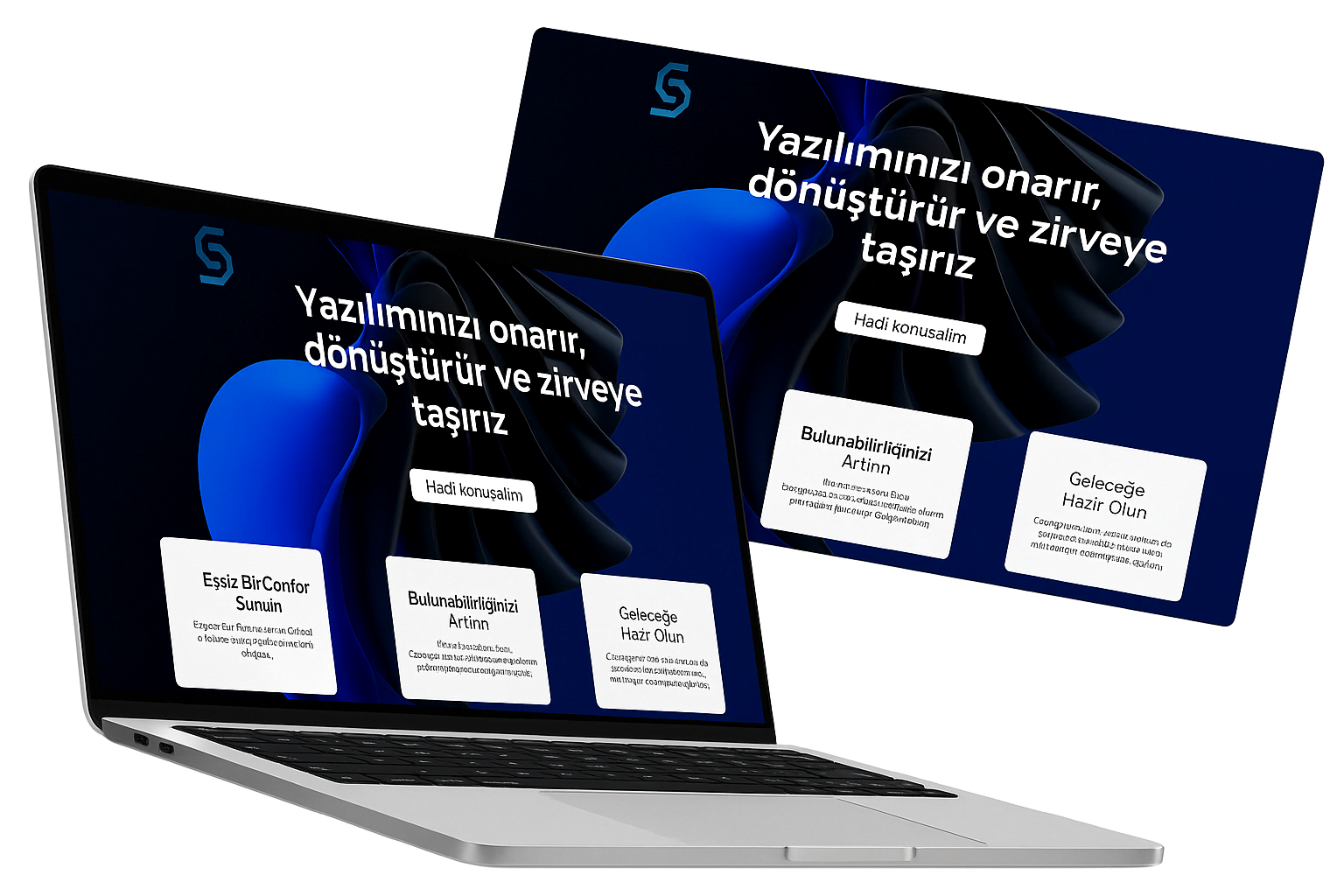
No matter which device your customers switch to, your product remains consistent. We undertake performance optimizations for faster loading times and fluid interactions; we ensure perfect adaptation to different screen sizes, including desktop, tablet, and phone. With our mobile-first approach, we achieve gradual UX construction, touch-friendly design, and cross-device consistency by centering dynamic values.
Frequently Asked Questions
We Repair, Transform, and Rapidly Develop Your Software.
Tell us where your system needs help; we’ll show you how to move forward with clarity and speed. We are your engineering partner from architecture to launch.
Book your free consultation. We’ll help you move faster and smarter.